
Publish Time:2025-09-15
Readings:574
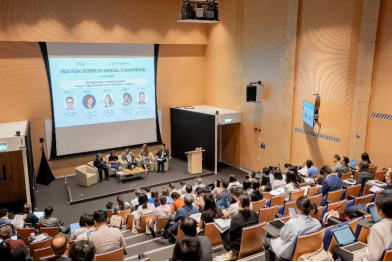
On September 10, 2025, the 2025 Risk Sciences Annual Conference was held at the Wee Cho Yaw Plaza (formerly Gaia) at Nanyang Technological University (NTU), Singapore. The conference was jointly organized by the Risk Sciences journal from the Tsinghua University School of Economics and Management and the Nanyang Business School, NTU. The event brought together experts and scholars from around the world to explore the future challenges of risk management and innovative pathways through a series of thematic forums and parallel sessions.
Mr. Min Hung Cheng, CEO of the Global-Asia Insurance Partnership (GAIP), delivered the opening remarks. Emphasizing that "what gets measured gets managed," he called for scientifically quantifying uncertainty, using foresight to resolve risks, and bridging protection gaps. Professor Runhuan Feng, Chair Professor at Tsinghua University School of Economics and Management and Executive Editor-in-Chief of Risk Sciences, proposed that risk science should break through traditional disciplinary boundaries and move towards deep interdisciplinary integration. He emphasized the need to jointly explore its inherent "unified theoretical core" and encouraged every researcher to maintain a curiosity for the unknown, embracing new challenges with an open mind and enduring inquisitiveness. Professor Adam D. Switzer from NTU introduced the university's Climate Transformation Programme, which encompasses research linking climate risk domains such as "Climate and Financial Markets" and "Climate and Human Health." Professor Shinichi Kamiya, Associate Professor in the Division of Banking & Finance at NTU and Co-Director of the Insurance Risk and Finance Research Centre, shared the Centre's ongoing investments, achievements, and experiences in risk and insurance research and education, and welcomed cross-regional collaboration. Associate Professor Wenjun Zhu, Associate Chair of the Division of Banking & Finance and Deputy Director of the Insurance Risk and Finance Research Centre at NTU, also delivered remarks, briefly reviewing the development history and achievements of her department and research centre in the interdisciplinary fields of insurance, risk, and finance, and providing a high-level overview of current disciplinary frontiers and future trends.
The conference focused on cutting-edge global risk topics, structured around three main thematic forums facilitating high-level dialogue on strengthening financial system resilience, climate change and response, and emerging risk governance. In the forum on strengthening financial system resilience, participants engaged in in-depth discussions on corporate risk, capital market dynamics, and retirement challenges. The dialogue focused on the sustainability of pension systems, capital market stability, and corporate governance mechanisms, offering new academic insights and policy implications for long-term financial security and social old-age support. The forum on climate change and response saw participants explore ways to enhance societal capacity to cope with extreme climate events using scientific data, modeling tools, and insurance innovations, thereby promoting the development of resilient infrastructure and sustainable financial mechanisms, from perspectives including climate risk modeling and climate finance. In the forum on emerging risk governance, multiple experts analyzed trends in artificial intelligence, digital health, and next-generation risk management. Topics covered generative AI governance, public risk perception, algorithmic transparency, and the digital health ecosystem, providing interdisciplinary perspectives for institutional design and responsible innovation in the context of rapidly advancing technology.
Furthermore, the conference featured four parallel sessions where participating scholars presented academic reports on a wide range of frontier areas, including biodiversity and environmental risk, AI risk, climate and sustainable finance, mortality and longevity risk, machine learning applications, catastrophe modeling, risk theory, insurance innovation, corporate responsibility, risk transfer instruments, auto insurance innovation, supply chain resilience, and fintech.
Through multi-dimensional and interdisciplinary dialogue, this conference provided a platform for in-depth exchange among scholars and practitioners from different fields, contributing important ideas and solutions for advancing global risk management and sustainable governance.

(Conference Scene)
Enterprise Ecosystem Construction Model Exchange Conference Successfully Held
2025-12-11
Workshop on Financial Mathematics and Actuarial Science Successful Held
2025-11-03
Risk Sciences Meets Domestic Journal Recognition Standards | Enabling Research to Take Root in China
2025-10-29
Anonymous Donation to Risk Sciences to Establish Best Paper Award at International Annual Conference
2025-09-30
2025 Risk Science Colloquium: "AI and Risk Management: Navigating Transformation, Shaping the Future" Successfully Concluded
2025-09-29